The Route To Success
I imagined freelancing as a method that doesn’t require me to leave my home and work at a confined office. Really, the first time I learned about freelancing, literally my brain went through the fact that I only needed a sense of creativity, the right tools, my laptop and the Wi-Fi for this work. My first thought was it would earn me more money in less time and less effort while sitting at my armchair. While that thought is not entirely wrong, it lacks the true definition. Less time, less effort, more money, sitting at home interpretation is almost accurate but the real thing is more diversified.
Freelancing is not just working from home but it is a profession that renders services to the clients independently without being confined to a single organization, institution or a company. The fun fact is that you can work according to your schedule, your comfort and render the types of services you’re expert in. Freelancing is simple but for beginners, you might need to grasp the basics of it.
In this article, we are going to discuss freelancing and navigate our ways throughout the basics even if you are a struggling beginner. Hopefully, this might help you.
What exactly is Freelancing?

Freelancing is a self- employed career that depends on the contracts and projects given by your clients. You can work to your schedule, choose your clients and operate every business transactions and other matters. Unlike a traditional office job, a freelancer usually has more control over where and when they work, although they still have to meet deadlines and complete the work according to the client’s requirements. In simple words, freelancing means turning a skill you have into a service that someone is willing to pay for. For example, a person who knows graphic design can create logos or social media posts for clients, while someone skilled in writing can provide articles, website content, or copywriting services.
What do you mean by a freelancer?
A freelancer is a self-employed person who works on numerous projects for multiple clients at a time and earns money per project.
There are a lot of things that a freelancer has to do by himself that an average employee doesn’t have to worry about. They typically set their own hours , keep track of how much time they spend on each task, negotiate payments with clients , and are responsible for their own taxes and business expenses . In most cases, the client doesn’t see the freelancer as a regular employee. The freelancer is instead an independent contractor.
Types of Freelancing
Freelancing is a diversified profession enlisting many kinds of jobs, services and skills in a single term. Any skill can be provided as a freelance service as the term indicates Free and Lance. In the medieval period, free meant a person who is not a royalty or bound to any noble family and Lance was the primary weapon used by the medieval knights. In simple words, Freelance were the warriors who could be hired for fighting in wars. After several decades, it got thoroughly modernized and transformed into the independent service work we see today. Interesting, huh? I found this fact just now, thought you might be as intrigued as me. Now imagine Freelancing has existed even before our grandparents were born, just in a different form.
Now let’s talk about the basic forms of Freelancing–
- Web Design: Designing a website along with setting each and every matters required to be fixed.
- Content Writing: Writing authentic articles, blog posts, website content, product descriptions etc.
- Graphic Design: Designing blog posts, product designs, Facebook and Instagram posts, digital posters, etc.
- Website Management: Managing a website after it has been built, removing dummy contents and managing its settings.
- Image Editing: Editing images as aesthetic, enhancing its quality and managing other settings.
- Video Editing: Editing reels, YouTube videos and shorts, advertisements and other video contents.
- Digital Marketing: Marketing based on online platforms and digital tools.
- Email Marketing: Advertising and attracting customers via virtual mailing platform.
- Youtube Marketing: Marketing related to YouTube.
- SEO Management: Increasing the visibility of any website on search engines.
- Virtual Assistance: Administrative tasks, communication, data entry, etc.
- Translation: Translating written or spoken contents between languages.
Basic Requirements for Freelancing
When I started learning freelancing, I wasn’t quite sure what I needed. A laptop, Wi-Fi and a chair? Yes, you need that, but you need more than just three things. The first two are fundamental requirements, but you need a hint of creativity and a few ideas to get you started. First and foremost, you need to find a small set of skills you are comfortable with. I started with digital marketing. But digital marketing is such a huge platform having various sub platforms within it, one of them being meta marketing.
- Choose the right skill :You don’t need to work with a lot of skills just the right one to get you started. For example, you can start with designing if you are creative enough and have good knowledge about it. I started with meta marketing, which felt a tad bit easy than other subjects of digital marketing.
- A computer or suitable device: In order to work with these types of tasks you need at least one laptop or a computer, because an android can only take you so far.
- Internet Connection: You definitely need this. Without it, none of your work can be accomplished.
- Know what kind of customers you are trying to attract: This is a great factor too, if you’re a designer you must indulge with people who run brands, recruits designers on basis of their ability.
- Build your own portfolio website: This is very important as it clearly introduces your biodata and information to the clients. You can even create a website without any programming via WordPress.
- Create an action plan: Creating a five day action plan for yourselves gives a much clearer routine to your brain and you may easily start to understand how to start working
- Practicing skills: Learning is easy but preserving the skill for a long time use might put a dent while becoming an expert. So if you’re a designer you might need to keep experimenting with color theory, techniques and principles of designing and develop a sense of creative designing with time.
Choosing the right skill as a freelancer
This is the most complicated part of the whole freelancing journey in my perspective. Everyone says, “You have to choose a right skill and get started with it.” But what they don’t understand is how difficult the actual thing is. Because freelancing is a diversified employment and has so many skills within it, we might lose count. For choosing the right skills, you need to understand yourself. You need to ask yourself what kind of work you enjoy and which job actually inspires you to show your intelligence and creativity. When an artist visits an art gallery, he gets confused as to which painting he is to buy, but seeing all of them one by one he comes across a piece that speaks to him and buys it. Choosing a skill is just like that.
Suppose you love writing, you have a broad vocabulary and you’re efficient in content writing. For you, content writing would be the best job. Just like that, for a person with artistic intellect, he may indulge in graphic designing and test himself whether he can efficiently become skilled in it or not. On the other hand, if you have the sense of marketing and the psychological thinking about how it usually works, then digital marketing is the ONE!
So, choosing the right skill isn’t only the matter of your thinking but also to understand where your efficiency lies. Therefore, select your own skill and get going on your way step by step. And voila! One day, you’ll see you became a great content writer, a digital marketer or a SEO manager.
Necessity of a Portfolio Website
Imagine that you got a project and your client asks you to show them your previous works but you realize you don’t have any. That’s where the concept of a portfolio website comes which help clients understand you. A portfolio website is a website that tells client about your profession, your identity and the skills you are expert. This type of website can also show your previous works, helping clients become more reliable on you.
A portfolio website can gather your work in one place and show:
- Who you are
- What service you offer
- Your skills
- Examples of your work
- Previous projects, if you have them
- Client testimonials, if available
- Contact information
Outsourcing Vs. Freelancing
Often you hear the terms ‘outsourcing’ and ‘freelancing’ merging together. A question definitely arises, “Are they same?” No they aren’t, though they are related, they do not proclaim the same thing. Freelancing refers to an independent person providing services to clients, whereas outsourcing refers to a company or individual assigning work to an external person or organization instead of completing it internally.
For example: A business hires you to give them 10 designs for Instagram posts. You delivered and get paid. That’s freelancing.
Again, a company needs someone to manage its various social media accounts, so they hire a outside freelancer or a marketing agency. That’s outsourcing.
Benefits of Freelancing
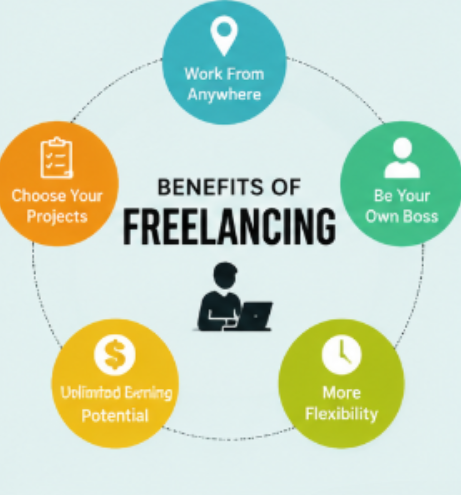
- Flexible Schedule: Work according to your available time.
- Work from Home: No need to travel to an office every day.
- Choose Projects: Pick work that matches your skills.
- Different Clients: Work with different people and businesses.
- Improve Skills: Gain experience through different projects.
- Control Your Workload: Decide how much work you can handle.
- Income Growth: Better skills can lead to better earnings.
- Build Your Portfolio: Every project can strengthen your experience.
- Global Opportunities: Work with clients from different locations.
- Independence: Have more control over your career.
Frequently Asked Questions
1.Can I learn Freelancing with no experience?
Yes, you can. You just need to acquire expertise in the useful skills, understand the basics and you can get to work. Clients may not always as for previous professional experience but they may want proof that you can complete work properly.
2. What is the best freelancing skill for beginners?
There is no single best skill for every beginner because it depends on a person’s interests and abilities. Some popular area include content writing, graphic design,digital marketing, video editing and others. Instead of chosing a skill thats profitable, you should choose something that you can pratice consistently without dying of boredom.
3. Do I need a portfolio before starting freelancing?
A portfolio is not always compulsory, but after you have acquired the basic of freelancing and are able to work without any hesitancy or complications you should create your own portfolio. Because potential clients may need to see your previous works and your profile before giving any projects.
4. Can students do freelancing?
Why not, absolutely. They can provide freelance services while studying and earn income. Freelancing is flexible and independent work, for which it allows students to gradually become financially independent by it.
5. Is freelancing easy for beginners?
It depends on your understanding ability and your potential. Learning about it is easy,but finding clients and becoming skilled can be tough. Starting is easy but being successful needs consistency and effort.
6. Can a freelancer become financially independent?
Yes, a freelancer can gradually become financially independent. Though it depends on potential clients and the experience level. It doesn’t immediately guarantee income but as time flows, and a person becomes experienced, skilled and reputation preceeds as a freelancer to the outer world, he starts to earn a consistent income.